Journal article
ASTIN Bulletin · 2021-09 · Volume 51 · Issue 3 · pp. 689-718
DOI: 10.1017/asb.2021.13
Published online: 2021-05-12 · Download citation (BibTeX)
Abstract
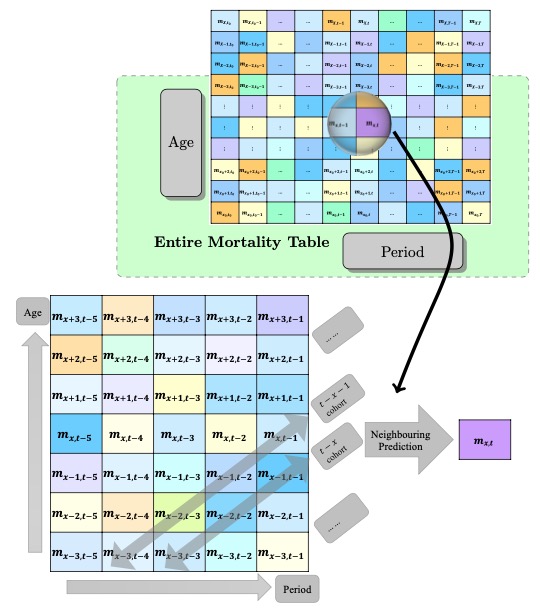
We propose new neighbouring prediction models for mortality forecasting. For each mortality rate at age x in year t, denoted as mx,t, we construct images of neighbourhood mortality data around mx,t, i.e., ℇmx,t (x1, x2, s), which includes mortality information for ages in [x − x1, x + x2], lagging k years (1 ≤ k ≤ s). Combined with the deep learning model - convolutional neural networks (CNN), this framework is able to capture the intricate nonlinear structure in the mortality data: the neighbourhood effect, which can go beyond the directions of period, age, and cohort as in classic mortality models. By performing an extensive empirical analysis on all the 41 countries and regions in the Human Mortality Database (HMD), we find that the proposed model achieves superior forecasting performance. This model can be further enhanced to capture the patterns and interactions between multiple populations.
Keywords: mortality forecasting; neighbourhood effect; artificial intelligence; deep learning; convolutional neural networks; longevity risk
Related material
Neighbouring prediction for m(x,t).